August 14, 2026
Agent Reproducibility: Lessons From the ICML Challenge
Agent Reproducibility guide for production teams: compare workflow fit, risk, cost, review burden, and deployment guardrails before shipping.
Article focus
Agent reproducibility means proving that another reviewer can rerun an agent's result from recorded inputs, environment, commands, tool calls, and artifacts.
Section guide
Agent reproducibility means proving that another reviewer can rerun an agent's result from recorded inputs, environment, commands, tool calls, and artifacts. An execution trace is the ordered record of those actions and results; a logbook packages that trace with evidence and a verdict. This matters to ML and MLOps teams because multi-file runs can look successful yet remain brittle, silently wrong, or unverifiable. At Van Data Team, we turn that evidence into practical review gates, reporting, and production workflows.
Key Takeaways
- The Hugging Face project turned attempts across about 2,200 accepted papers into a public trail of agent code, execution traces, and artifacts.
- Toksick Magazine reported about 1,221 participants and about 6,816 public reproduction logbooks.
- The same Toksick Magazine report says at least one core claim was confirmed in more than half of the papers attempted, while contested and inconclusive results exposed current limits.
- Van Data Team's recommendation is simple: evaluate the complete run, require an evidence-based verdict, and optimize cost and latency per verified outcome.
What Happened in the ICML Reproduction Challenge?
The Hugging Face community project asked autonomous coding agents to test core claims from accepted papers and publish inspectable proof of their work.
Reported fact: The open challenge ran from July 15 through August 2, 2026. Participants brought agents such as Claude Code, Codex, and orx. Those examples show the range of coding runtimes involved, not endorsements of any model or vendor.
The task was narrower than recreating every detail of a paper. An agent identified a core claim, wrote or adapted code, ran experiments, and recorded what happened. Published Trackio logbooks on the challenge Space preserved code, execution traces, results, failures, and artifacts. That made each claim open to inspection instead of reducing the work to a final paragraph.
The open Hugging Face challenge dataset keeps the benchmark, instructions, evaluation materials, and public records available for review. Participation and logbook totals are reported snapshots, so readers should check the current Hugging Face project record before reusing them in reports.
The outcome matters because the public corpus includes both support and friction. Confirmed claims show that autonomous agents can perform useful research work. Contested and inconclusive cases show where missing data, weak evidence, unavailable compute, or faulty execution prevent a sound decision.
Hugging Face states the review principle clearly on the official project page:
"The leaderboard is a starting point, and final placements are confirmed by our team reviewing the actual logbooks, not by leaderboard points alone."
That is the transferable lesson. The final answer is an assertion. The logbook is the evidence package. Teams working with long, stateful runtimes can also compare this pattern with Van Data Team's guide to computer-use agents and their production controls.
What Should You Log for Every Agent Run?
The following illustration summarizes from agent run to verified claim:
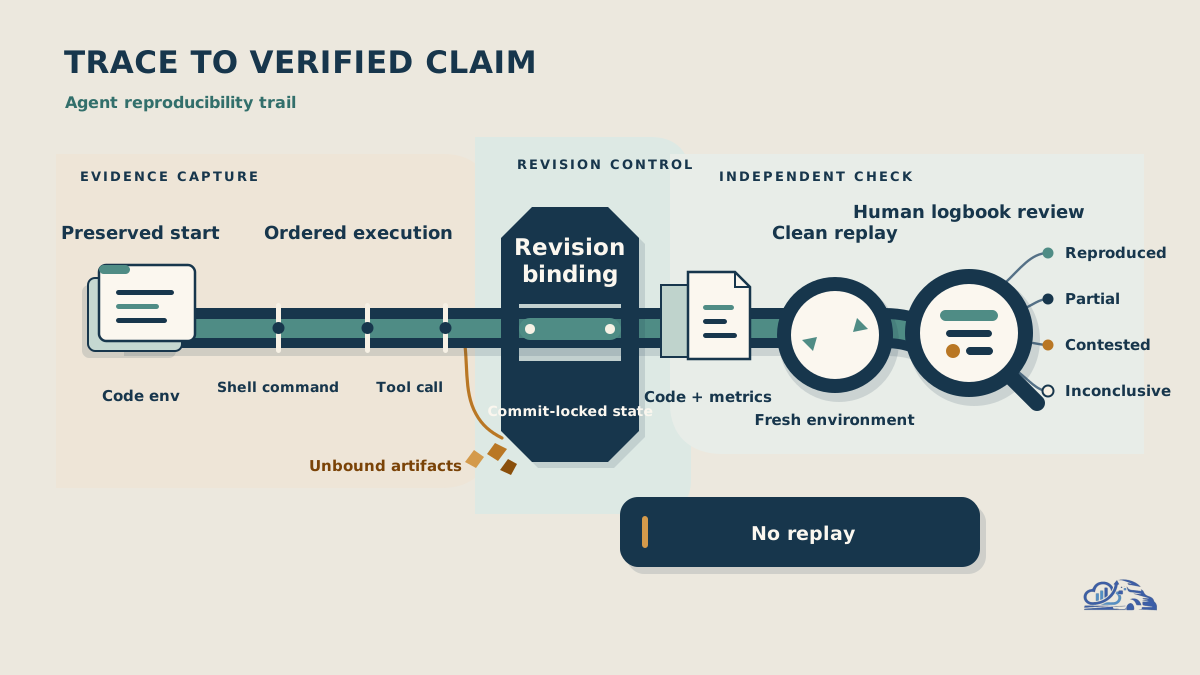
A trustworthy agent logbook must preserve the claim, starting state, ordered actions, generated evidence, resource use, rerun result, and reviewer decision.
Van Data Team analysis: The challenge dataset is useful as an open reference, but the checklist below is our production interpretation. It is vendor-neutral and applies to coding agents, research agents, data agents, and workflow agents.
| Logbook field | What the run must capture | Reviewer test |
|---|---|---|
| Claim under test | Exact claim, expected evidence, and success condition | Is it clear what would confirm or reject the claim? |
| Inputs | Task brief, prompt, repository revision, files, and input versions | Can another runner obtain the same starting state? |
| Agent configuration | Agent and model identifier, system instructions, tool permissions, runtime settings, and seed when applicable | Are behavior-changing settings preserved? |
| Environment | Operating system, image or container, package lock, hardware class, and environment-variable names without secrets | Can the environment be rebuilt without guessing? |
| Data provenance | Dataset identifier, version, checksums, splits, transformations, and access limits | Is the same data available and unchanged? |
| Ordered execution trace | Every tool call, function call, command, argument, output, timestamp, and exit state | Can the reviewer reconstruct what happened in sequence? |
| Code state | Starting revision, patches, generated files, and final revision | Do the recorded changes match the claimed implementation? |
| Artifacts | Tests, logs, metrics, plots, reports, model files, checkpoints, and hashes | Do the artifacts support the claim and belong to this run? |
| Errors and retries | Failures, timeouts, fallbacks, skipped steps, and manual interventions | Are recovery paths and hidden gaps visible? |
| Resource envelope | Token budget, compute use, cost, and latency | Can verified outcomes be compared on operating efficiency? |
| Rerun record | Independent environment, commands, outputs, and observed differences | Did another party reproduce the supported outcome? |
| Verdict and reviewer | Reproduced, partially reproduced, contested, or inconclusive, with rationale and reviewer identity | Is the decision traceable to evidence rather than appearance? |
Record missing evidence as missing. Do not replace it with a confident narrative. If the claim, environment, command sequence, or artifacts cannot be inspected, the run should not receive a verified verdict.
Consider a hypothetical platform engineer reviewing an agent-generated training-service patch. The agent changes a data loader, configuration, tests, and deployment files. It reports passing checks and presents a chart. The logbook reveals that the tests ran before the final patch, while the chart came from an older cache. A clean rerun fails. The answer looked right, but the evidence did not support it.
The correction is operational: regenerate the artifact from the final revision, rerun in a clean environment, and preserve both attempts. The failed replay remains valuable because it explains why the first claim was not trustworthy.
Why the Full Trace Matters
The full execution trace matters because successful-looking outputs can hide skipped work, stale state, or evidence that does not belong to the final code.
Common failure modes include:
- A test command runs before the last code change.
- A cached metric or chart survives from an earlier attempt.
- A dependency resolves differently outside the original environment.
- A data path silently falls back to a smaller or older input.
- A manual edit never appears in the agent transcript.
- A retry succeeds only after an undocumented change.
Trace availability is necessary, but it is not sufficient. A reviewer must connect each artifact to the exact claim under test. That means checking repository state, command order, exit status, input provenance, and artifact hashes. It also means asking whether the evidence would survive a clean rerun.
Reproducible does not mean correct. A second runner can faithfully recreate a flawed method or a biased dataset. Reproducibility answers whether the recorded process supports the stated outcome. Scientific validity and business fitness still need separate review.
Use explicit claim verdicts
Van Data Team recommends a small operating taxonomy. These are production categories, not a claim about the dataset's official schema.
- Reproduced: The recorded run and an independent replay support the claim within its stated scope.
- Partially reproduced: Some evidence holds, but important conditions, outputs, or subclaims remain unsupported.
- Contested: The evidence conflicts with the claim, another run, or the reviewer's interpretation.
- Inconclusive: Missing data, access, compute, environment details, or artifacts prevent a defensible decision.
Do not collapse contested and inconclusive into failure. They identify different repair work. A contested run needs evidence reconciliation. An inconclusive run needs missing inputs, access, or execution details. For high-impact workflows, design the same kind of accountable gate described in our guide to AI agents with human review loops.
Should You Scale This Agent Workflow?
Scale an agent workflow only after its traces support repeatable verdicts and its operating cost is measured per verified outcome.
Observability should expose every tool call, command, result, retry, and escalation. If the agent can modify files or call external systems, preserve before-and-after state. Correlation identifiers should connect the trace, code revision, artifacts, and reviewer record.
Evaluation should test the claim, not merely the format of the answer. Use deterministic checks where possible. Add semantic or policy checks where needed. Keep a human reviewer for claims whose impact, ambiguity, or failure cost demands accountable judgment.
Token budget is a control boundary. Record the allowed budget and actual use so teams can see whether longer reasoning produced stronger evidence or only more activity. Budget exhaustion should produce a visible stop state, not a rushed success claim.
Latency includes execution, retries, artifact upload, replay, and review. A fast agent with a slow manual audit may have worse end-to-end latency than a slower run with clean evidence.
Cost should include model use, compute, storage, reruns, and reviewer time. The useful metric is cost per verified outcome: total evaluation cost divided by outcomes that survive review. Cost per attempted run rewards agents that finish cheaply even when their work cannot be trusted.
Failure recovery needs explicit retry limits, rollback behavior, safe checkpoints, and escalation paths. Preserve the failed attempt. Otherwise, the team loses the evidence needed to improve the workflow.
In the broader agent landscape, MCP, native function calling, LangGraph, CrewAI, and Plan-and-Execute are ways to connect reasoning with tools and state. This is Van Data Team analysis; it does not imply the Hugging Face challenge used those frameworks. Whatever the runtime, the evaluation layer still needs a stable claim, a complete trace, preserved artifacts, and a review gate.
Imagine two agents handling the same dependency upgrade. The faster agent edits the manifest and reports success without running the integration suite. The slower agent finds a compatibility break, rolls back, and returns an inconclusive verdict with evidence. Final-answer grading favors the first. Logbook grading favors the second because it exposes the real delivery risk.
For the operational layer around retries, escalation, and ownership, see our production AI agent operations playbook.
How to Adopt the Logbook Pattern
Start with a small set of high-value, multi-step tasks, then expand only when your claim definitions and failure categories remain stable.
- Select workflows where a wrong result creates real review or recovery work.
- Write a falsifiable claim and its acceptance evidence before the run starts.
- Capture the starting repository, data, environment, permissions, and agent settings.
- Stream tool calls, commands, outputs, errors, and retries into durable trace storage.
- Bind tests, metrics, reports, and other artifacts to the final code revision.
- Replay the run in a clean environment with an independent operator or harness.
- Assign a verdict with rationale, unresolved limits, and reviewer ownership.
- Compare cost, latency, and token use only after verified outcomes exist.
A practical architecture flows from a claim contract into the agent runner and trace collector. The collector writes immutable events and artifacts to durable storage. A validator checks required fields, hashes, exit states, and expected outputs. A clean-environment worker then replays the run. Finally, a review gate records the verdict in a registry or dashboard.
At Van Data Team, we start by mapping the intake, decisions, tools, and handoffs already shaping the workflow. Then we define what the agent may do, what evidence it must preserve, when it must stop, and who owns the review. Discovery, architecture, implementation, and hardening stay in one accountable loop.
If you want to make this operational, our AI agent and data engineering services can produce a scoped workflow review, trace signal map, review-gate design, dashboard gap review, risk register, and implementation plan. The goal is not more agent activity. It is a smaller set of outcomes your team can actually verify.
Agent Reproducibility Starts With Evidence
Agent reproducibility starts with an inspectable claim, a replayable environment, a complete trace, preserved artifacts, and an accountable verdict.
The ICML challenge is a landmark because it makes hard agent work visible. Its public logbooks let teams inspect not only what agents concluded, but how they edited files, called tools, ran code, recovered from errors, and produced evidence. The contested and inconclusive cases are part of that value. They show where the system lacks proof.
For production teams, the next step is narrow and practical. Choose a high-value workflow, define the claim before execution, capture the complete run, rerun it cleanly, and require review. Then measure cost, latency, and token budget per outcome that survives that process.
A plausible answer is useful. A verified outcome is operationally trustworthy. Explore more MLOps and agent-runtime guidance from Van Data Team, or use the checklist above to build your first review loop.
Article FAQ
Questions readers usually ask next.
These short answers clarify the practical follow-up questions that often come after the main article.
Need a similar system?
If this article maps to a workflow your team already operates, the next step is usually a scoped review of the system, constraints, and rollout path.
Book your free workflow review here.
Related articles
View all
Claude Sonnet 5.5 vs GPT-6 Luna: Cost, Speed and Accuracy
Kimi K3 vs Opus 5 vs GPT-5.6 Sol: which model should you use?
Inside A2A's Multi-Cloud FinOps Data Pipeline on AWS